
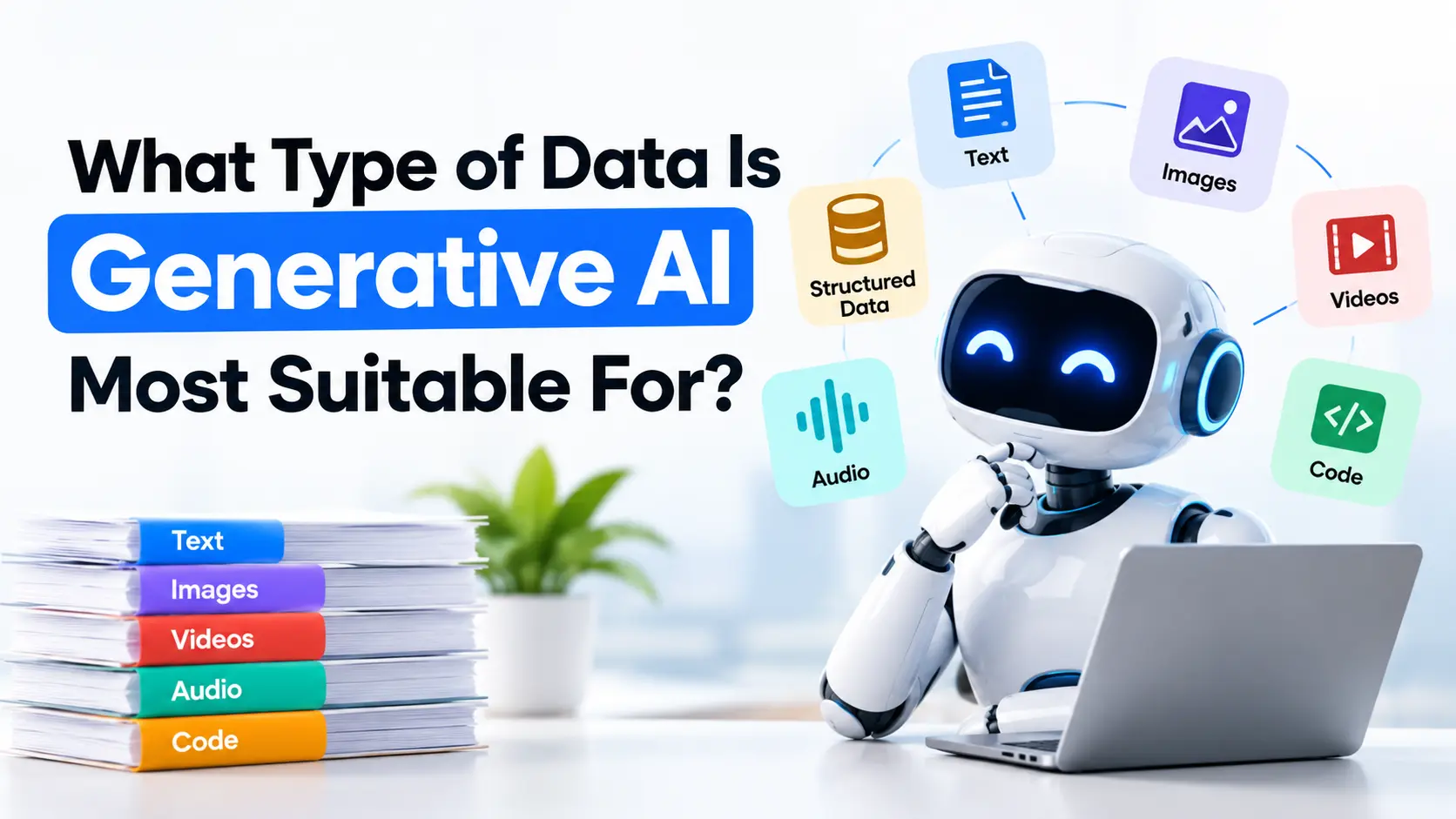
Short answer: Generative AI is most suitable for large volumes of unstructured, pattern-rich data such as text, images, audio, video and source code. These formats are high-dimensional and full of learnable structure (grammar, shapes, rhythm, syntax), which lets a model learn the underlying distribution of the data and then generate new, similar examples. It can also work with structured and time-series data, but in narrower roles.
Quick Answer for Exams and Quizzes
Multiple-choice versions of this question usually look like “A. Text data B. Image data C. Structured data D. All of the above.”
- If “unstructured data” is an option, that is the best answer.
- If the options are text, image, structured data and “all of the above,” many course answer keys mark all of the above, since generative models exist for each of these data types.
Check your own course material, because answer keys differ.
Why Unstructured Data Is the Best Fit
Generative models do not look up answers. They learn the statistical patterns of their training data and then sample from them. That works best when the data is:
- Rich in patterns. Language has grammar and context. Images have edges, textures and composition. Audio has pitch and rhythm.
- Abundant. The web provides enormous amounts of text, images and code.
- Learnable without manual labels. Modern models use self-supervised learning. An LLM predicts the next token, and an image model learns to remove noise. No human has to label every example.
Unstructured data (text, images, audio, video) also makes up the large majority of data most organizations hold, so this is where generative AI delivers the most value.
Data Types Generative AI Handles Best
| Data type | Examples | Typical model families | Suitability |
| Text | Articles, chats, documents, emails | Transformer-based large language models (GPT, Gemini, Claude, Llama) | Very high |
| Code | Python, JavaScript, SQL, configs | Code-tuned LLMs, GitHub Copilot-style assistants | Very high |
| Images | Photos, art, design, product mockups | Diffusion models (Stable Diffusion), GANs, Midjourney, DALL·E | High |
| Audio and speech | Voice, music, sound effects | Neural audio codecs, transformers, diffusion; tools like ElevenLabs | High |
| Video | Short clips, animation, editing | Video diffusion and transformer models (Sora, Veo) | Medium to high, costly |
| Multimodal | Text + image + audio together | Multimodal transformers | High and growing |
| Time series | Sensor data, prices, vitals | Transformers, diffusion, VAEs | Medium |
| Structured / tabular | Spreadsheets, databases, transactions | CTGAN, TVAE, tabular diffusion models, LLMs for text-to-SQL | Medium, narrow use |
| Scientific (molecules, proteins) | Protein structures, chemistry | Diffusion and graph-based models | Emerging |
Each Data Type in Practice
Text
Text is the foundation of today’s generative AI. Large language models built on the Transformer architecture (introduced in the 2017 paper “Attention Is All You Need”) learn from books, websites, code and conversations. They power chatbots, summarization, translation, drafting and search assistants. The weak spot is hallucination: fluent text is not always accurate text.
Code
Code is text with strict rules, which makes it very learnable. Models can autocomplete functions, write tests, translate between languages and explain errors. The output still needs review, testing and security checks before it goes to production.
Images
Diffusion models learn to turn random noise into a coherent image, guided by a text prompt. GANs, introduced by Ian Goodfellow and colleagues in 2014, pioneered realistic image synthesis. Large image-text datasets such as LAION-5B made text-to-image tools possible. Common weaknesses are fine details, text inside images and exact control.
Audio and Speech
Audio is converted into spectrograms or discrete tokens so models can learn rhythm, tone and phonemes. Uses include text-to-speech, voice cloning, music generation and noise removal. Consent and misuse (voice cloning, deepfakes) are the main concerns.
Video
Video adds time to image generation: frames must stay consistent with each other. Models like Sora and Veo have improved fast, but video remains the most compute-hungry and least consistent mainstream format.
Multimodal
Multimodal models take in and produce several formats, such as describing an image, answering questions about a chart, or generating images from text. Real-world information is mixed-format, so this is where the field is heading.
Time-Series and Structured Data
Generative AI is not the first tool for exact calculations. Spreadsheets, SQL and classic machine learning remain better for precise numbers. Generative models still help in specific ways:
- Synthetic tabular data, for testing and privacy protection. Research on financial transaction data compares GANs, TVAE and diffusion models for this task.
- Missing-value imputation and anomaly baselines.
- Text-to-SQL, where an LLM turns a plain-language question into a database query.
- Time-series simulation and forecasting support in finance and healthcare.
So structured data is not “unsuitable,” but it is a narrower fit. Use generative AI to create, fill or query it, and use traditional tools to calculate with it.
Data Quality Matters More Than Data Type
Even the best-suited format fails if the data is poor.
- Volume and diversity: too little or too narrow data gives repetitive or biased output.
- Cleanliness: duplicates, noise and errors get learned and reproduced.
- Bias: a model reflects the gaps and stereotypes in its data.
- Licensing and copyright: training data rights are an active legal and ethical issue.
- Privacy: personal or confidential data should not go into public tools.
- Synthetic data loops: training repeatedly on AI-generated output can degrade quality over time (often called model collapse).
When Generative AI Is Not the Right Tool
- Exact financial or scientific calculations
- Medical, legal or compliance decisions without expert review
- Security-critical code shipped without testing
- Any task where one wrong number or fact is unacceptable
Common Challenges and Ethics
The main challenges are hallucinations, bias, high compute cost, data privacy, copyright disputes and misuse such as deepfakes. Responsible use means verifying outputs, documenting where AI was used and keeping a human in the loop.
Frequently Asked Questions
What type of data is generative AI most suitable for?
Unstructured, pattern-rich data such as text, images, audio, video and code.
Can generative AI work with structured data?
Yes, but in narrow roles: synthetic data generation, imputation, anomaly baselines and text-to-SQL. It is not a replacement for databases or spreadsheets for exact calculations.
What kind of data can be input into generative AI systems?
Text prompts, images, audio, video, documents, code and tables, depending on whether the model is text-only or multimodal.
What type of deep learning algorithms used by generative AI do not need labeled data?
Unsupervised and self-supervised learning. Examples are next-token prediction in LLMs, GANs, VAEs and diffusion models.
What is the primary goal of a generative AI model?
To learn the patterns of its training data and generate new content that resembles it, such as text, images, audio or code.
Is unstructured data better than structured data for generative AI?
For generating new content, usually yes. For precise analysis and prediction on tables, traditional machine learning often works better.
What is a major challenge of generative AI?
Reliability: hallucinated facts, biased outputs and unclear data rights, all of which need human review.
Conclusion
Generative AI is best suited to unstructured, pattern-rich data (text, images, audio, video and code), and increasingly to multimodal combinations. It can assist with structured and time-series data, but it should not replace exact calculation tools. Choose the model for your data type, check data quality first, and always verify the output.
Read also:- New Technology 2022 in Computer Science: Top Trends and Breakthroughs