
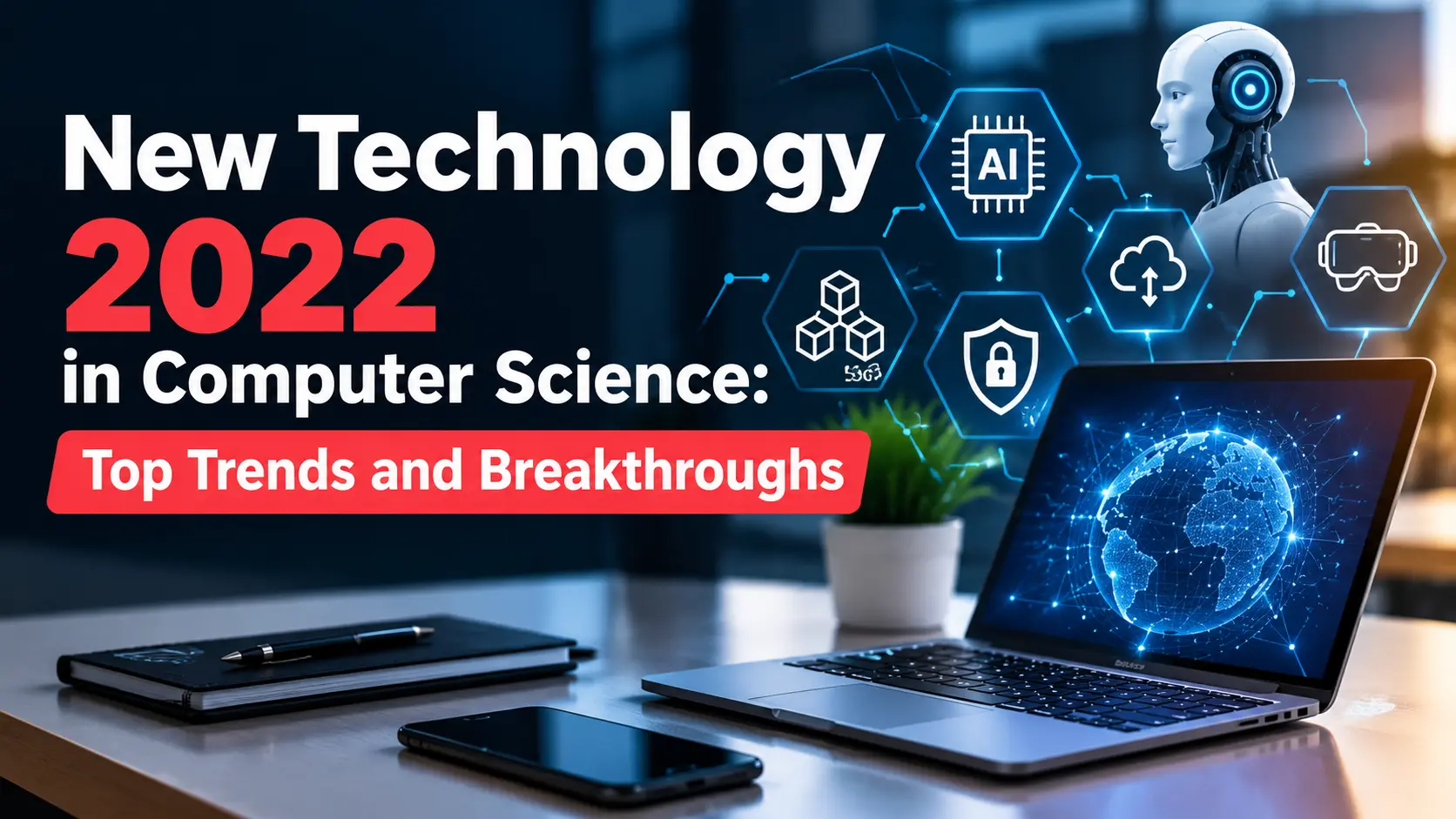
New technology 2022 in computer science marked the year when artificial intelligence, quantum security and supercomputing moved from research papers into real products. ChatGPT reached the public, the Frontier supercomputer broke the exascale barrier, NIST picked its first post-quantum encryption algorithms, and India launched 5G. In this guide, we break down each major breakthrough with verified facts, dates and what it means today.
Quick Answer: New Technology 2022 in Computer Science
The biggest new technology in computer science in 2022 included generative AI (ChatGPT, DALL·E 2, Stable Diffusion), the first exascale supercomputer (Frontier), NIST’s first post-quantum cryptography standards, Ethereum’s move to proof-of-stake, and the Matter smart home standard. Other major trends were data fabric, hyperautomation, confidential computing, zero trust security, edge computing and the 5G rollout, including India’s launch on October 1, 2022.
Key Takeaways
- Generative AI was the defining breakthrough of 2022, led by ChatGPT (November 30, 2022).
- Frontier at Oak Ridge National Laboratory became the first officially exascale supercomputer.
- NIST selected its first post-quantum encryption algorithms in July 2022.
- Ethereum’s Merge cut the network’s energy use by about 99.95%.
- Gartner’s 2022 trend list highlighted data fabric, hyperautomation and generative AI.
- India launched 5G services on October 1, 2022.
1. Generative AI Goes Mainstream
2022 was the year generative AI moved from research labs to everyday use.
- DALL·E 2 (OpenAI) was announced in April 2022.
- Midjourney entered open beta in July 2022.
- Stable Diffusion (Stability AI) was released as open source in August 2022.
- GitHub Copilot became generally available in June 2022.
- ChatGPT launched on November 30, 2022, and brought large language models (LLMs) to a mass audience almost overnight.
These tools started the AI race among OpenAI, Google, Microsoft, Meta and Anthropic, and changed how people write, search, design and code.
2. Exascale Computing: The Frontier Supercomputer
In May 2022, the Frontier supercomputer at Oak Ridge National Laboratory (built by HPE with AMD processors) topped the TOP500 list as the first system to officially pass the exascale barrier: more than one quintillion (10^18) calculations per second. Exascale power is used for climate modelling, drug discovery, materials science and AI training.
3. Quantum Computing and Post-Quantum Cryptography
- In July 2022, the U.S. National Institute of Standards and Technology (NIST) selected its first post-quantum algorithms: CRYSTALS-Kyber for key establishment, and CRYSTALS-Dilithium, Falcon and SPHINCS+ for digital signatures. They are designed to protect data from future quantum computers that could break RSA and elliptic-curve encryption.
- In November 2022, IBM unveiled Osprey, a 433-qubit processor.
- The 2022 Nobel Prize in Physics went to Alain Aspect, John Clauser and Anton Zeilinger for experiments on quantum entanglement, the foundation of quantum information science.
Quantum hardware in this period belonged to the noisy intermediate-scale quantum (NISQ) era: useful for research, but still error-prone.
4. Data Fabric and Hyperautomation
Gartner’s Top Strategic Technology Trends for 2022 included data fabric, hyperautomation, cybersecurity mesh, decision intelligence and generative AI.
- Data fabric is an architecture that connects data across cloud, on-premises and edge systems through one automated layer, which reduces data silos.
- Hyperautomation combines robotic process automation (RPA), AI and process mining to automate as many business and IT processes as possible.
5. Confidential Computing and Zero Trust Security
- Confidential computing protects data while it is being processed, using hardware-based trusted execution environments such as Intel SGX and AMD SEV. The Confidential Computing Consortium, part of the Linux Foundation, promotes open standards in this area.
- Zero trust (“never trust, always verify”) went mainstream when the U.S. Office of Management and Budget issued its federal zero trust strategy (memo M-22-09) in January 2022.
6. Blockchain: The Ethereum Merge
On September 15, 2022, Ethereum completed “The Merge,” switching from proof-of-work to proof-of-stake. The Ethereum Foundation reported that this reduced the network’s energy consumption by roughly 99.95%, one of the largest efficiency gains in a major software system.
7. AI for Science: AlphaFold and AlphaTensor
- In July 2022, DeepMind expanded the AlphaFold database to over 200 million predicted protein structures.
- In October 2022, DeepMind’s AlphaTensor discovered new algorithms for matrix multiplication, a core operation in computing.
- Researchers also published a much faster algorithm for the maximum-flow problem, one of the oldest questions in computer science, as covered by Quanta Magazine.
8. 5G, Edge Computing and IoT
5G adoption grew sharply in 2022. India launched 5G services on October 1, 2022, with Reliance Jio and Bharti Airtel among the first operators. Faster networks supported edge computing, which processes data close to where it is created instead of in a distant cloud data center. This lowers latency for autonomous vehicles, video conferencing, industrial IoT and AR.
9. Computer Hardware in 2022
| Hardware | Maker | Launch |
| H100 GPU (Hopper) | NVIDIA | Announced March 2022 |
| M2 chip | Apple | June 2022 |
| Ryzen 7000 series (Zen 4) | AMD | September 2022 |
| 13th Gen Raptor Lake | Intel | Announced September 2022 |
| GeForce RTX 4090 (Ada Lovelace) | NVIDIA | October 2022 |
10. Smart Home, Metaverse and AR/VR
The Matter 1.0 smart home standard was released in October 2022 so devices from different brands could work together. Meta launched the Quest Pro headset in October 2022, and the metaverse was one of the most talked-about technology topics after Facebook rebranded as Meta in 2021.
2022 vs Today
| Technology | In 2022 | Today |
| Generative AI | New and experimental, ChatGPT just launched | Built into everyday software and workflows |
| Post-quantum cryptography | NIST selected first algorithms | NIST published the first final standards in August 2024 |
| Exascale computing | Frontier was the first | El Capitan (Lawrence Livermore) topped TOP500 in November 2024 |
| Metaverse | Huge hype | Hype cooled; AI took the spotlight |
| Edge and cloud | Growing separately | Increasingly combined for AI workloads |
Latest Research Areas and Seminar Topics in Computer Science
If you are a student looking for new topics in computer science, these areas grew out of the 2022 wave:
- Generative AI and large language models
- Post-quantum cryptography
- Edge AI and federated learning
- Explainable AI
- Zero trust architecture
- Confidential computing
- Data fabric and data mesh
- Neuromorphic computing
- Digital twins
- AI in healthcare
- AR/VR and spatial computing
Frequently Asked Questions
What are the new technologies in computer science in 2022?
Generative AI, exascale computing, quantum and post-quantum cryptography, data fabric, hyperautomation, confidential computing, zero trust security, blockchain (proof-of-stake), edge computing, 5G and AR/VR.
What was the biggest computer science breakthrough of 2022?
Most experts point to the public launch of ChatGPT on November 30, 2022, which made large language models widely accessible.
What are the top 3 trends in computer science?
In 2022 the top three were generative AI, quantum computing and edge computing, with cybersecurity (zero trust) close behind.
What is new technology in computer science in India in 2022?
Besides global trends, India’s biggest 2022 development was the 5G launch on October 1, 2022, by Reliance Jio and Bharti Airtel.
Which supercomputer was the first exascale system?
Frontier, at Oak Ridge National Laboratory, in 2022.
What is post-quantum cryptography?
Encryption designed to stay secure against quantum computers. NIST selected its first algorithms in 2022.
What is data fabric?
A data architecture that integrates data across cloud, on-premises and edge environments through automated, unified management.
What are good seminar topics in computer science?
Generative AI, post-quantum cryptography, edge AI, explainable AI, zero trust, digital twins and neuromorphic computing.
Is 2022 technology still relevant today?
Yes. Most of today’s AI tools, security standards and computing infrastructure build directly on 2022 developments.
Conclusion
New technology 2022 in computer science was not just a trend list; it set the foundation for the tools we use now. Generative AI became everyday software, post-quantum cryptography moved toward real standards, and exascale computing opened new doors for science. If you are a student, developer or tech reader exploring new technology 2022 in computer science, these breakthroughs are the best place to start understanding where computing is heading next.
See also:- Techslassh.com | Exploring the Future of Technology